Sweden - Births in 2023
A quick update while Sweden's 2023 figures are finally out.
This will be a quick update to my recent article on the topic1, following the release of the 2023 figures. It will simply involve changing a few inputs in the already written code to provide an updated analysis of birth rates by mothers' age groups.
A longer article will follow over the weekend, focusing on New Zealand's latest Freedom of Information (FOI) data.
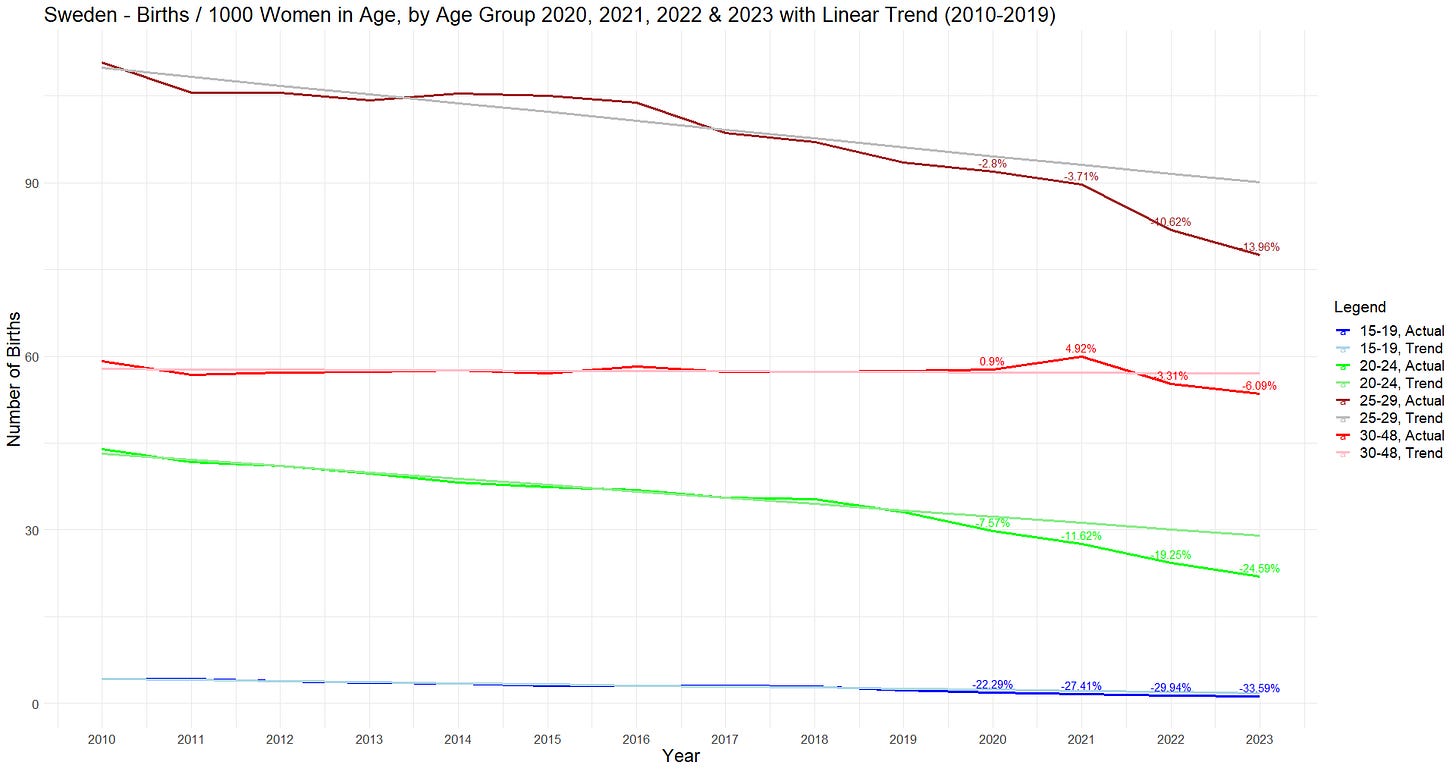
For some global considerations when compared to the 2010-2019 baseline, Z-score & deviation to linear trends are the following (the “Deviation from linear trend” being the number of babies you would have expected to be born).
- 2020 - Z-score: -1.040018, Deviation from linear trend: -3006, Percentage of deviation: -2.589471%
- 2021 - Z-score: -0.287173, Deviation from linear trend: -2069, Percentage of deviation: -1.778172%
- 2022 - Z-score: -6.335957, Deviation from linear trend: -11846, Percentage of deviation: -10.161431%
- 2023 - Z-score: -9.308615, Deviation from linear trend: -16778, Percentage of deviation: -14.361058%
Thanks for reading OpenVAET’s Substack! Subscribe for free to receive new posts and support my work.
Sources
Data on births comes from this table.
- Region : Sweden → All Sweden
- Age of the mother : “Alder, 1-arsklasser och 2 grupper” → Select all
- Sex : men, women
- Year : 2000 → 2023
Save results as → CSV with headings.
Data on women’s population & marriage comes from this table.
- Observations : Population
- Region : Sweden → 00 Sweden
- Marital Status : Select all
- Age : Age, 1 year age classes → Select all
- Sex : Men, Women
- Year : 2000 → 2023
Save results as → CSV with headings.
The useless first 2 lines are removed from the resulting .CSV files.
The code & raw files used are available on GitHub.
💬 Join the conversation
Want to like, comment, or share this article?
Head over to our Substack page to engage with the community.
Likes, comments, and shares are synchronized here every 5 minutes.