In Memory of Christine Cotton
1970 - 2026
Les lecteurs francophones peuvent trouver cet article ici.
Christine Cotton, a bio-statistician and whistle-blower on the COVID-19 vaccines, passed away on June 1st, 2026. After a year and a half of unbearable, unrelenting suffering to which medicine failed to bring any answer - Christine sought assisted death as a final resort.
Christine was an exceptional woman - one of the very few, here in France, to have resisted with her face uncovered; never once abandoning her irreverent wit, her courage, her commitment to professionalism, her fight for the recognition of victims, or her quest for the truth.
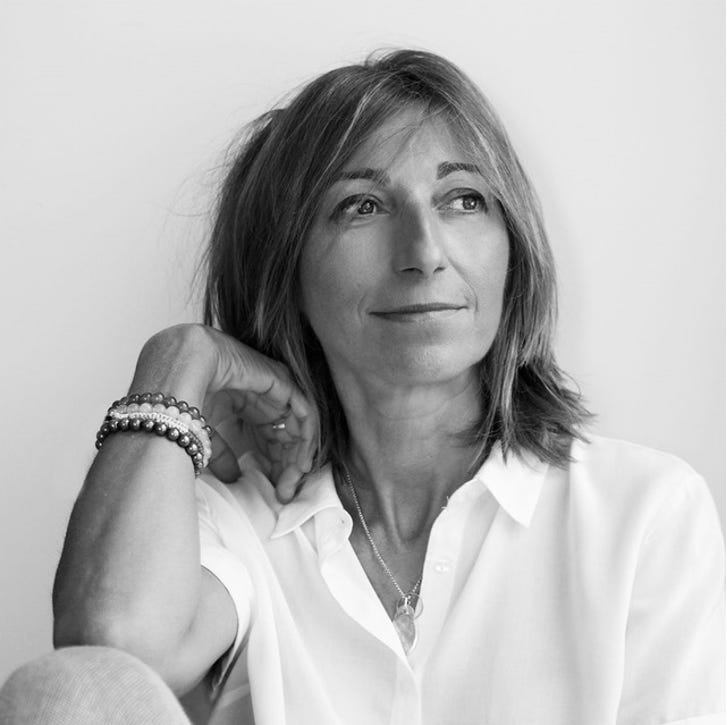
I had the honor of knowing her, of working with her and calling her my friend, and I wished to share with you a few memories of her, along with a few elements that may help in appreciating her work.
Christine was born on 27 April 1970 on the French Riviera, in Cannes. We never had the time to speak of her childhood - I know only that she grew up in a loving family, alongside her sister.
Between 1992 and 1993, she earned a science degree at the Faculty of Economic Sciences in Toulouse. In 1993, she began a magistère (a specialized graduate degree) in economics and statistics, which she would complete in 1997.
Alongside her studies, in 1995, at the age of 25, came a “first miracle”: she was noticed by a professor at her university who had heard of her and of her independent spirit, and who recommended that she meet the head of bio-metrics at the Pierre Fabre laboratories. He hired her. There, she learned the craft - and fell in love with bio-statistics.
A year later, her director introduced her to her future partner: the head of a clinical research organisation that did not yet have a bio-statistics department. Together, they founded Statitec, a Clinical Research Organisation.
Over the course of her twenty-two-year career, she worked for the best-known pharmaceutical groups: AstraZeneca, Aventis, Bayer, Ceva, Danone, Janssen, Merck, Novartis, Roche, Pierre Fabre, Sanofi, Servier, Takeda…
A formidable worker, she drafted countless study protocols:1 those highly codified documents, developed in collaboration with regulators, that make it possible to determine whether a drug works - or not.
In particular, between 2013 and 2017, she oversaw the Phagoburn study, which was awarded to her company by the Department of Defense.2
On 30 July 2018, Christine sold Statitec. She wanted to enjoy life; to found an eco-haven - a twelve-hectare estate she bought in the Bresse region - to savor nature there and relish a freedom earned after a life of hard work. And to play music, which she had taught herself - she was a talented pianist and multi-instrumentalist.
On 16 December 2019, Christine released, with her group of friends “Ms Butterfly and the flying wolves,” their first track, “Sur les photos en noir et blanc.”3 Others followed: “Elle veut juste,”4 “Le Love,”5 “Et même si j’suis pas Dieu,”6 “Mister Mauvais Temps - Mister Bad Weather.”7
Then came 2020, and COVID. Christine initially resisted, through her music, a climate she attributed more to an abuse of power than to a concern for protecting the most vulnerable, as well as the rise of health totalitarianism, by composing several odes to freedom: “L’effet Pangolin,”8 “135 balles,”9 “Le Nouveau Monde,”10 “Le Jour du Dernier Jour,”11 “My Ave Maria.”12
In November 2020, the first results of the Pfizer/BioNTech vaccines were published, and Christine - an expert bio-statistician who trusted only the figures she had checked herself - devoted herself to studying them in depth.
Between November 2020 and April 2021, she developed a deep understanding of the flaws in the trials of the four vaccines that would be authorised: Pfizer/BioNTech, Moderna, J&J and AstraZeneca.
She was also one of the first to conduct a serious analysis of VAERS - and to observe the disastrous state of pharmacovigilance in light of her own professional ethics.
Five months later, in April 2021, Christine made her “coming out” as a dissident.13 Interviewed by France Soir, she stressed that, at that point, no efficacy against severe cases had been statistically proven for Pfizer or Moderna; that the vaccines’ efficacy was of undetermined duration; and that the Pfizer trial protocol, loosely drafted, left room for various games with definitions - between “local and central laboratory,” “suspected but unconfirmed COVID,” and other methodological flaws, such as failing to test participants systematically and at regular intervals by PCR. All points directly sourced, and explained patiently by Christine.
In August 2021, Christine wrote an analysis of the VAERS data for the CSI,14 which she presented alongside another whistle-blower, Amine Umlil.15 She emphasized the alarming number of deaths reported within a short interval after vaccination, as well as the abnormal proportion of reported miscarriages.
She also acknowledged - to herself - that she had become a whistle-blower in the sense of French law: “A whistle-blower is a natural person who reports or discloses, without direct financial consideration and in good faith, information concerning a crime, an offence, a threat or harm to the general interest, a violation or an attempt to conceal a violation of an international commitment.”16
She allied herself with many associations fighting the mandating of an experimental product for children, such as the “Mamans Louves,” as well as with victims’ associations that were emerging in 2021 - “Verity France,” for example. Christine made herself available to victims, whether she contacted them herself or was put in touch with them. To all of them she gave an attentive ear, her compassion, and connected them, when she could, with doctors who took their experience seriously.
In November 2021, Christine contacted Frédéric Beltra - the father of Maxime - who died on the evening of his Pfizer injection, at the age of 22. Frédéric Beltra became her friend and her companion in the struggle, in the fight to see the vaccine manufacturers’ responsibility recognized in his son’s death.
In January 2022, Christine completed a first in-depth, 110-page report17 and met Mélodie Féron, the future founder of the association “Où est mon cycle?”18 That same month, she took part in the Québec programme “Science en conscience no. 20: Injection - what if the clinical trial results were wrong?,”19 alongside Gloriane Blais and Jérémie Mercier. On 31 January, the Québec lawyer drew on this report to challenge childhood vaccination - which earned her a summons before a disciplinary board and a court-ordered psychiatric evaluation, a sign of the weight of the prevailing dogma that bore, at the time, on anyone who dared question the “safe and effective” vaccines.20
In February 2022, she presented this report through a new interview with France Soir.21 22 She also decided to engage on social media. She created a Twitter account23 and a Telegram channel,24 where tens of thousands of French people, and hundreds of thousands of people around the world, signed up to follow her. She devoted herself to informing the public online,25 and was interviewed by Dr. Eric Loridan,26 who would become her friend. Nor did she abandon work on the ground: she also took part in a conference with Member of Parliament Martine Wonner.27
On Twitter - now X - Christine found herself up against the TV-pundit doctors,28 the narrative promoted by Pfizer,29 and the procession of trolls, whom she handled with her devastating humor. To the packs that branded her “anti-vax” - she who had devoted her career to safe and effective drugs and vaccines - she would retort, to the Mamans Louves, that she was no more anti-vax than she was anti-lasagne; but that when a dish of lasagne used spoiled meat, it was only normal to point it out.30
She was among the first to draw attention to the case of Maddie de Garay, in the United States - a 12 year old girl enrolled in the clinical trial whose health had been devastated after her Pfizer injection, and whose adverse effects had been ignored by the principal investigator at her trial site.31 A week later, she already had 16,000 followers.32 She challenged various media outlets over the report of another adolescent death, a 15-year-old, in the United States.33 A famous French journalist, André Bercoff then invited her for a first interview, on 24 February 2022.34
Unfortunately, the attention her research attracted also sparked a barrage of hatred, vile threats, and constant defamation. On Twitter, she had become an elite troll-exterminator.35 In private, she confided her dismay at the relentless harassment she was subjected to - some samples of which she had cataloged on her site under the heading “My critics.”36
On 13 May 2022, she was again a guest of André Bercoff.37
On 24 May 2022, she presented her objections to the OPECST (the French Parliamentary Office for the Evaluation of Scientific and Technological Choices).38 Her hearing, to this day, has still not been made public - unlike that of most other contributors. No concrete action has been taken to shed light on the many anomalies she had flagged - despite countless subsequent confirmations of the points to which she had drawn attention.39
On 4 June 2022, I exchanged with Christine for the first time, after I had reproduced and updated her VAERS analysis.40 She had thanked me for it, and we had exchanged contact details. That same month, she was interviewed by Identity and Democracy and by Ligne Droite, at the European Parliament, with Virginie Joron.41 42
In October 2022, she presented her work to the Network of Vaccine Injury Victims (REVAV).43
In November 2022, I began working on the Pfizer data with the teams at DailyClout, Naomi Wolf’s organisation - with whom I worked until early March 2023.44
Also in November 2022, Christine met Brook Jackson4546 - the Ventavia whistle-blower in the United States who, as a regional director for one of the companies running the Pfizer trial, had testified to serious violations of good clinical practice.47 Christine also drew attention to the case of Augusto Roux - a trial participant whose pericarditis was recorded, in Argentina, by the study’s lead author as “pneumonia” - and who, when he reported his adverse effects to the principal investigator at his Argentine site, found himself accused (by a pediatrician) of being paranoid and mad.48 The matter is currently under investigation in Argentina.
In December 2022, Christine and I spoke again by telephone, as I was beginning to take an interest in the anomalies in the Pfizer data - which were being released on a rolling basis, by order of a Texas judge, through phmpt.org. I had a knack for spotting anomalies in the data, but no experience of good clinical practice. I had asked Christine for help in interpreting the anomalies I had found, and she had immediately agreed. We became friends at once, and began exchanging almost daily - validating, or invalidating, each other’s new findings.
I introduced her to other researchers I worked with regularly: Josh Guetzkow - a professor at the Hebrew University of Jerusalem; Dr Jeyanthi Kunadhasan, of Naomi Wolf’s team, an anesthetist suspended in Australia and an expert in the Pfizer protocols and data; and other colleagues, who remained anonymous, working through those hundreds of thousands of pages.
In January 2023, she filed a first complaint with the French autorities, on behalf of the victims, for poisoning.49 The complaint was dismissed without further action.
In March 2023, Christine made another major discovery: that, as early as March 2021, Pfizer was aware of the very rapid decline in antibodies - which we were being sold, at the time, as one of the vaccine’s principal mechanisms of protection.50 That same month, we clarified the mortality during the trial, at a time when many false figures - inflating the real mortality thirty-fold - were being circulated to discredit the dissidents.51
On 2 April 2023, we published an in-depth analysis of the subject of the antibodies decline - analysis showing that not only were the antibodies falling, but that the same measurements, ossn the same subjects, on the same day, had yielded several drastically different readings - a major anomaly in a trial of this kind.52 That same month, she had greatly helped Josh Guetzkow and me to verify another serious question: 301 subject identifiers that had “vanished” from the files - concentrated for the most part in Argentina, and coinciding in good part with the enrollment of Augusto Roux.53 On 7 April, she met with the courageous Member of the European Parliament Michelle Rivasi - since deceased - and presented her conclusions to her.54 In May 2023, she reported on her work before the Citizens’ National Inquiry Commission in Canada,55 and on the program “Elo veut savoir.”56
On 8 June 2023, her book came out in French: Tous vaccinés, tous protégés? Vaccins COVID-19, Chronique d’une catastrophe sanitaire annoncée (“All Vaccinated, All Protected? COVID-19 Vaccines: Chronicle of a Foretold Health Disaster”), published by Éditions Trédaniel.57 She announced the publication on Radio Courtoisie that same day.58 For the occasion, her website - redesigned, and containing her work made freely available to all - went live at christinecotton.fr.59 On 14 June, she spoke with Nicolas Dupont-Aignan.60 On 15 June 2023, we presented our main work to Pierre Chaillot of Décoder l’Éco.61 We also presented these conclusions in English to Peter McCullough and to the CSI.
Throughout 2023, she spoke out again and again: Epoch Times62 and, once more, André Bercoff in June;63 Éric Morillot’s “Les Incorrectibles” in July;64 Bercoff again in September;65 then TVL, with Élise Blaise, in October.66 In February 2024, she presented her conclusions to Pierre-Yves Rougeron, of the Cercle Aristote67, et en mars à son ami et journaliste, Nicolas Bouvier.68
In May 2024, we published a complete summary of the cardinal points of our work - of a kind to convince any good-faith reader of the urgent need for an audit of most of the trial sites.69
In April 2024, I visited her at her home to help her refine a new complaint against the health authorities, for deception. We worked, and shared good meals, surrounded by her friends, over several days. Christine carried on alerting the public, and was interviewed in English for Planetlockdown.70
The work then continued - with almost daily exchanges.
In January 2025, she told me she was feeling unwell, and had withdrawn to the French Riviera to rest. There began for her an ordeal of more than a year, from specialist to specialist, in search of a diagnosis and of solutions. On 12 February, she announced, on X and on the Tocsin program, the filing of her new complaint, and her withdrawal from public debate for as long as she needed to attend to her health.71
On 1 November 2025, in a public message, Christine laid bare where her ordeal stood. Since January, an illness that no doctor could name had been wearing her down: burning skin, excruciating pain, tremors, symptoms that only worsened despite the procession of specialists she consulted and the hundreds of supplements and treatments she tried, all to no effect. The illness had gradually cut her off from the world: she no longer left her home, taking a shower had become an expedition, and she had been forced to give up the farm where she had dreamed of building her eco-haven, taking refuge with her family. Around her, everything seemed to be dying at once - her canaries, her plants, and even her dog, which she had had to give away and then learn had been put down. To this accumulation of losses was added the dismissal of her complaint, despite evidence she considered irrefutable. Exhausted, her appetite gone, she confided that she often thought of death, and was no longer sure she would “win” this trial.72
In January 2026, she had found the strength, in the midst of her calvary, to publish a thoroughly revised version of her report - expanded to 432 pages.73
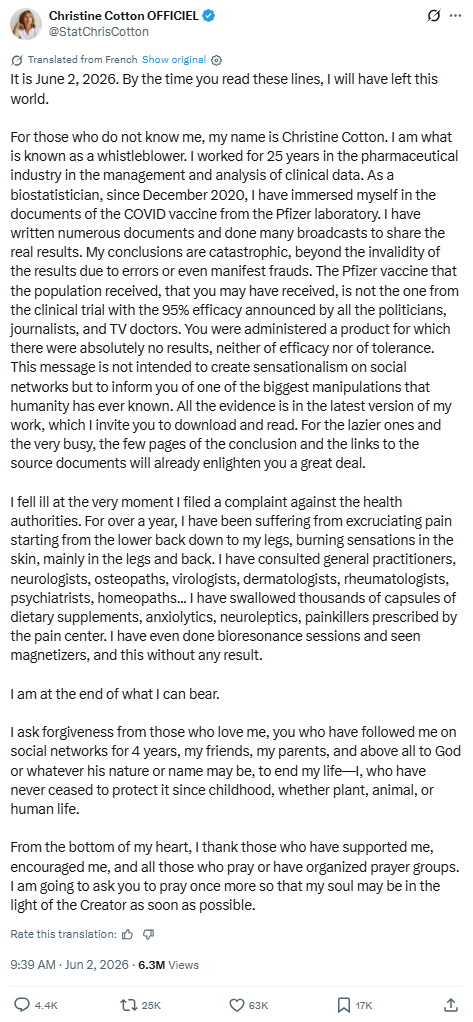
On June 1, she ended her life through assisted suicide in Switzerland. She was 56 years old. Her request, submitted to an organization in Basel, had been approved several months earlier. The next day, a friend, following her instructions, published her final post on her Twitter account.74
My thoughts go first to her sister, her parents and her loved ones, who loved her before any of us, and to whom the heaviest grief now falls.
Tributes have poured in from around the world. But no vigil, however large, will fill the void she leaves - nor erase, in those who loved her, the bitter feeling of having failed one of the best among us.
What remains is what she leaves us: the demand never to compromise with rigor, the refusal to look away, and that irreverent wit that disarmed fear. Christine did not merely defend analyses; she listened to victims no one else would hear, reached out to strangers in the night, and gave her voice to those who had lost their own.
In her last words, she wrote that she had never ceased to protect life - plant, animal, human. Perhaps that is her truest epitaph.
It now falls to us to keep her memory alive by sharing and carrying on her work with the same integrity. The world will take time to measure what it owes her; those who knew her already know. One does not replace Christine Cotton - one strives, humbly, to be worthy of her.
💬 Join the conversation
Want to like, comment, or share this article?
Head over to our Substack page to engage with the community.
Likes, comments, and shares are synchronized here every 5 minutes.
💬 Join the conversation
Want to like, comment, or share this article?
Head over to our Substack page to engage with the community.
Likes, comments, and shares are synchronized here every 5 minutes.